بازدیدکننده گرامی این صفحه در حال بروزرسانی و بازطراحی میباشد لذا ممکن است در حال حاضر برخی از مطالب قابل رویت نباشند
- As per ASTM D 2084, ISO 3417
- Torque range: 200~0 dN.m
- PID temperature controller with optimum response speed
- Drawing torque-time, and temperature-time graphs (upper and lower dies)
- Calculating curing and scorch times, as well as curing rate index for curing curves
- Capable of fluctuation amplitude mechanical setting (1º, 2º, and 5º)
- Constant frequency fluctuation, 66/1Hz (100cpm)
- Fully computerized
- High repeatability and reliability
- Easy maintenance
- Ease of use
- Equipped with torque calibration instrument, in dead weight and fluctuation angle method
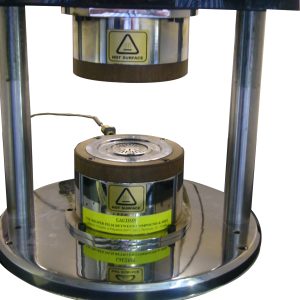
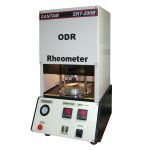
ODR, series SRT-200B is used to evaluate and determine the rubber compound characteristics. For this purpose, a sample of vulcanizable rubber compound is place in the die cavities and a rotor is placed between two dies filled with rubber compound, but the temperature of dies should reach to a certain level previously. Test starts with just one click and the dies get closed, then the rubber compound surrounds the whole disc; disc starts swinging with a predetermined amplitude (1º, 2º, and 5º). This will create a sinusoidal variable strain in the test piece and applies a sinusoidal shear strain on it. Torque meter connected to rotor axis measures the applied torque, the value of which depends on the stiffness of the shear module for each rubber compound. Temperature controllers, with fast response, provide a constant temperature for testing as per standards. Torque-temperature curves are registered displayed constantly as a function of time. Rubber specimen stiffness increases as the vulcanization process keeps going. Test is over only when the test piece is cured, and the registered torque has reached to the balanced value or has been reversed. If the curing curve was ascending, then test is over upon reaching to a certain torque or a predetermined time; the complete results are displayed under the curve. Automated sample removal tool enables the operator to take out the cured specimen and clean the disc. SRT-200 software performs all test procedures automatically. Operator can use an ordinary PC when the machine is connected to serial port; no network interface card (NIC) is required. The machine dies are of modular design to reduce the time and cost. Dies consist of heater, sensors, insulating material, body, and standard chamber; each of these parts and components can be replaced or repaired as an individual part if needed. Change in swinging angle is applied mechanically and part replacement is not required; the operator should only set the crank manually. All electronic sections of SRT-200 are integrated in an internal board, connected to a PC via RS-232. Due to digital signal processing technology (DSP), the mentioned board is highly qualified that no setting is needed; its installation and replacement is easy so that a technician can replace it within a couple of minutes.
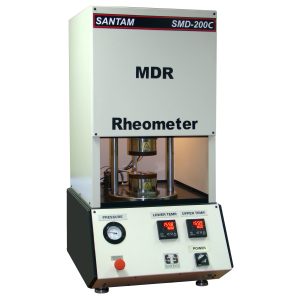
Oscillating Disc Rheometer (ODR) is intended to perform quality control and determine the rubber compound characteristics in curing process, as well as research and development of such compounds to evaluate various raw materials.
You must be logged in to post a review.

SRT-200B Catalog
قبل از ادامه دادن، مطمئن شوید که نام محصول را کپی کردهاید
برای دسترسی به این فرم لازم است به حساب کاربری خود در سایت سنتام وارد شوید
سازنده:
شرکت طراحی مهندسی سنتام
استعلام قیمت
درخواست مشاوره
دانلود کاتالوگ
شرایط تحویل حضوری
شرایط تحویل کالا در محل کارخانه
جزییات بیشتر
شرایط ارسال دستگاه
شرایط ارسال دستگاه و حمل آن
جزییات بیشتر
متن آزمایشی
متن آزمایشی
جزییات بیشتر
گارانتی دستگاه
شرایط خدمات پس از فروش
جزییات بیشتر
جزییات بیشتر
- As per ASTM D 2084, ISO 3417
- Torque range: 200~0 dN.m
- PID temperature controller with optimum response speed
- Drawing torque-time, and temperature-time graphs (upper and lower dies)
- Calculating curing and scorch times, as well as curing rate index for curing curves
- Capable of fluctuation amplitude mechanical setting (1º, 2º, and 5º)
- Constant frequency fluctuation, 66/1Hz (100cpm)
- Fully computerized
- High repeatability and reliability
- Easy maintenance
- Ease of use
- Equipped with torque calibration instrument, in dead weight and fluctuation angle method
ODR, series SRT-200B is used to evaluate and determine the rubber compound characteristics. For this purpose, a sample of vulcanizable rubber compound is place in the die cavities and a rotor is placed between two dies filled with rubber compound, but the temperature of dies should reach to a certain level previously. Test starts with just one click and the dies get closed, then the rubber compound surrounds the whole disc; disc starts swinging with a predetermined amplitude (1º, 2º, and 5º). This will create a sinusoidal variable strain in the test piece and applies a sinusoidal shear strain on it. Torque meter connected to rotor axis measures the applied torque, the value of which depends on the stiffness of the shear module for each rubber compound. Temperature controllers, with fast response, provide a constant temperature for testing as per standards. Torque-temperature curves are registered displayed constantly as a function of time. Rubber specimen stiffness increases as the vulcanization process keeps going. Test is over only when the test piece is cured, and the registered torque has reached to the balanced value or has been reversed. If the curing curve was ascending, then test is over upon reaching to a certain torque or a predetermined time; the complete results are displayed under the curve. Automated sample removal tool enables the operator to take out the cured specimen and clean the disc. SRT-200 software performs all test procedures automatically. Operator can use an ordinary PC when the machine is connected to serial port; no network interface card (NIC) is required. The machine dies are of modular design to reduce the time and cost. Dies consist of heater, sensors, insulating material, body, and standard chamber; each of these parts and components can be replaced or repaired as an individual part if needed. Change in swinging angle is applied mechanically and part replacement is not required; the operator should only set the crank manually. All electronic sections of SRT-200 are integrated in an internal board, connected to a PC via RS-232. Due to digital signal processing technology (DSP), the mentioned board is highly qualified that no setting is needed; its installation and replacement is easy so that a technician can replace it within a couple of minutes.

Reviews
There are no reviews yet.