





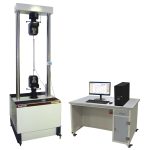

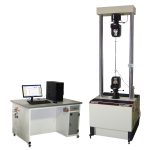
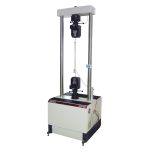
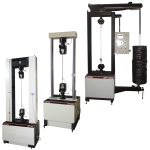
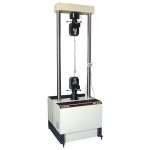
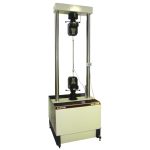
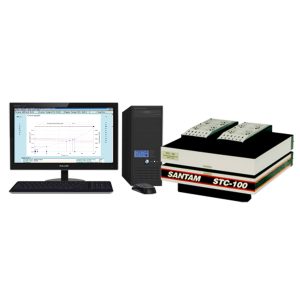
In relaxation test, a certain stress is applied to the specimen as per standard and the sample elongation is controlled on a constant value. Then the decrease in force (to keep the specimen under the same conditions) is obtained over time. The results of this test are highly important in design of structures and bridges. The load capacity of SRT-400 ensures the relaxation test up to 40 tons load. The machine control is fully computerized and can communicate with the system via RS-232 serial port, using DSP hardware technology. The software has the capability of perform the followings: relaxation test, displaying “force drop over time” graphs, controlling the strain on the test piece as per standard, obtaining important parameters from the curve, real time displaying of force, force drop and test time, recording and recalling the test data. A load cell with the capacity of 40t with linear degree of 0.03% FS and creep 0.02% Fs within 30 minutes (US or European made) is used to measure force with 5N resolution. The distance between two grips is measured by displacement sensor (shaft encoder) with resolution better than 0.05 micron, the feedback of which ensures the precise control during the relaxation test. It has servo electrical operating mechanism via precision ball screw with servo driver motor and gear motor. Grip and load cell are attached to the machine by pins and can be easily replaced. Grips are of wedge type to clamp metal specimens with round and rectangular (bar and belt) pneumatically. To increase the machine capability, three sizes of wedges with different diameters can be mounted (d=3-8mm, d=07-18mm, d=17-28mm for testing three sizes of PC strands, diameters 0.6″, 1/2″, and 3/8″. It should be noted that the grip stroke is maximum 150mm, and the maximum distance for installing the specimen is 1000mm (manually adjusted). The machine velocity for performing the test is 0.0001-100mm/min (capable of performing one test with two definable speed rates) as per the standard requirements. To calculate the exact strain as well as the specimen elongation, a special extensometer -10mm stroke, resolution 0.001mm and base length 700mm (can be increased up to 1000mm on the request)- can be used, in which linear encoder transducer or linear potentiometer sensor (accuracy 0.1% F.S with the least noise and temperature effects on communicating signals) or digital dial gauge is used. The machine has special grips on PC wire specimens with diameters d= 3~9 and d= 9~20mm.
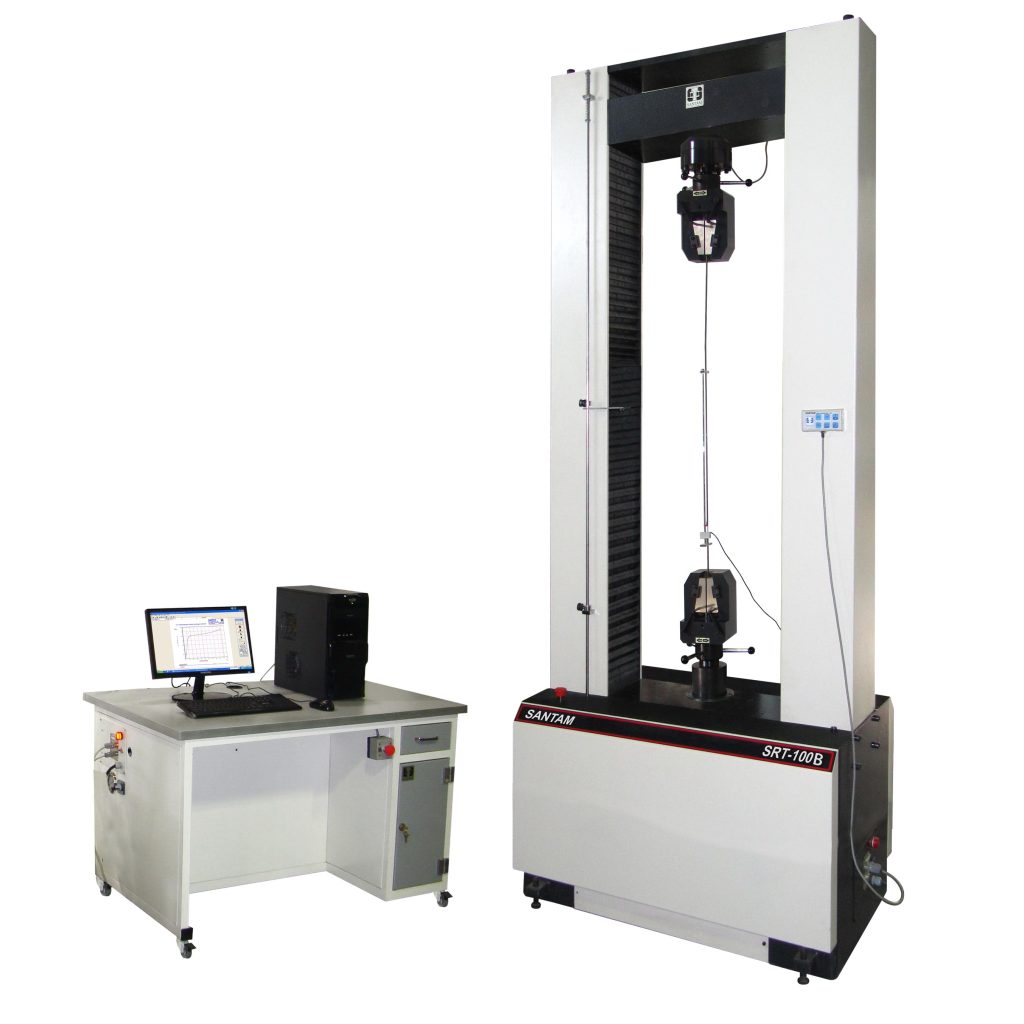


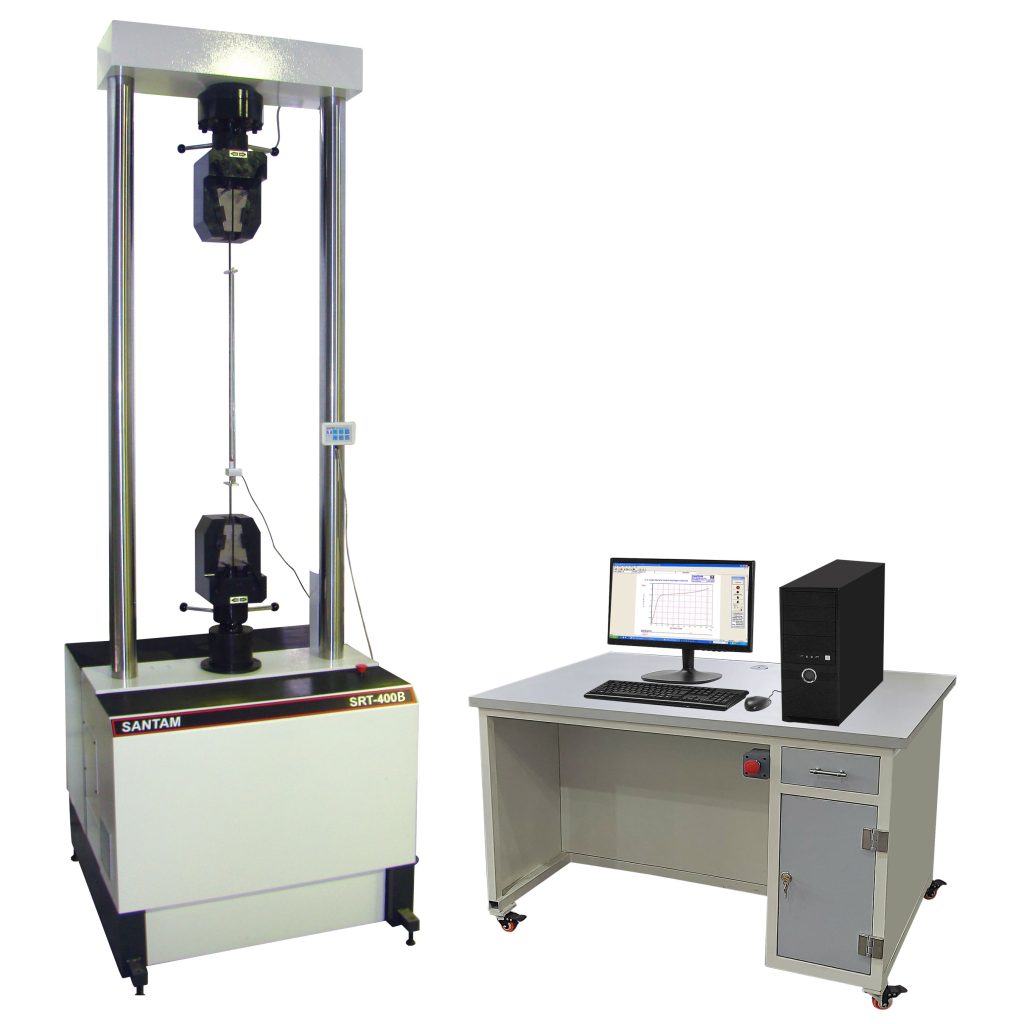

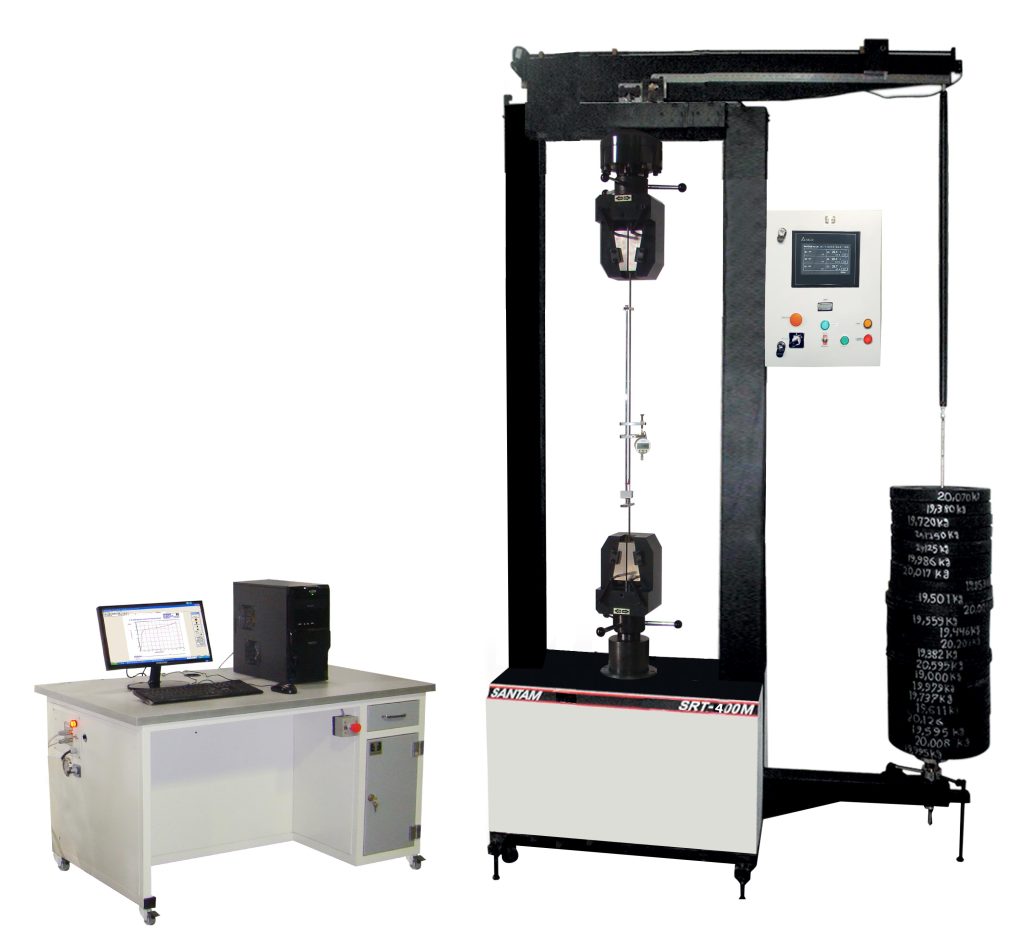
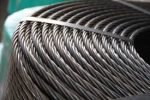
SRT-400B is intended to long term relaxation test for metals, special alloys, steel wires as well as pre-stressed PC wires and PC strands. The test results can be used in design and QC for concrete structures, bridges, suspension bridges, etc. at ambient temperature. Moreover, it can be used in different fields such as R&D, and QC of products such as:
•Testing and checking the PC wires
•Shielded or unshielded wires
•QC of strands
You must be logged in to post a review.

In relaxation test, a certain stress is applied to the specimen as per standard and the sample elongation is controlled on a constant value. Then the decrease in force (to keep the specimen under the same conditions) is obtained over time. The results of this test are highly important in design of structures and bridges. The load capacity of SRT-400 ensures the relaxation test up to 40 tons load. The machine control is fully computerized and can communicate with the system via RS-232 serial port, using DSP hardware technology. The software has the capability of perform the followings: relaxation test, displaying “force drop over time” graphs, controlling the strain on the test piece as per standard, obtaining important parameters from the curve, real time displaying of force, force drop and test time, recording and recalling the test data. A load cell with the capacity of 40t with linear degree of 0.03% FS and creep 0.02% Fs within 30 minutes (US or European made) is used to measure force with 5N resolution. The distance between two grips is measured by displacement sensor (shaft encoder) with resolution better than 0.05 micron, the feedback of which ensures the precise control during the relaxation test. It has servo electrical operating mechanism via precision ball screw with servo driver motor and gear motor. Grip and load cell are attached to the machine by pins and can be easily replaced. Grips are of wedge type to clamp metal specimens with round and rectangular (bar and belt) pneumatically. To increase the machine capability, three sizes of wedges with different diameters can be mounted (d=3-8mm, d=07-18mm, d=17-28mm for testing three sizes of PC strands, diameters 0.6″, 1/2″, and 3/8″. It should be noted that the grip stroke is maximum 150mm, and the maximum distance for installing the specimen is 1000mm (manually adjusted). The machine velocity for performing the test is 0.0001-100mm/min (capable of performing one test with two definable speed rates) as per the standard requirements. To calculate the exact strain as well as the specimen elongation, a special extensometer -10mm stroke, resolution 0.001mm and base length 700mm (can be increased up to 1000mm on the request)- can be used, in which linear encoder transducer or linear potentiometer sensor (accuracy 0.1% F.S with the least noise and temperature effects on communicating signals) or digital dial gauge is used. The machine has special grips on PC wire specimens with diameters d= 3~9 and d= 9~20mm.




Reviews
There are no reviews yet.