
بازدیدکننده گرامی این صفحه در حال بروزرسانی و بازطراحی میباشد لذا ممکن است در حال حاضر برخی از مطالب قابل رویت نباشند

  • Designed in accordance with ASTM-D6110, ASTM-D256, ISO-9854, ISIRI 12828  DIN 50115 standards in Charpy and Izod testing procedures,
  • For research purposes, and can be implemented as per different standards (with different release angles, impact velocities as well as various pendulums)
  • Various pendulum with different capacities can be offered and installed easily as per pertinent standards
  • Precise design of pendulum based on the center of percussion, analyzed by CAD-CAE
  • Fulfilling calibration and calculation of the machine friction during 11 semi-cycle swings of the pendulum and a half cycle swing forward via software
  • Full test report including impact, release angle and pendulum lift angle, impact velocity, pendulum percussion center, energy on cross section and friction losses
  • Connectable to PC via RS-232 serial port for sending data to computer
  • Mechanical joints and connections with slight friction
  • Pendulum manual lift/release controls
  • Equipped with Plexiglas protection, and can be mounted on the table
  • Digital angle measuring system
  • Digital LCD display
  • Easy maintenance

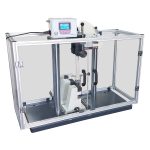
The SIT-50B impact testing machine is designed especially for academic and industrial research applications, providing high-precision evaluation of fracture the behavior and energy absorption mechanisms of polymer specimens under high-rate dynamic stress. A pendulum with a precisely specified mass, drop height, and geometry is released from a predetermined angle to strike and fracture a specimen. Following the impact, the pendulum continues its upward swing to a certain height. The difference between the initial release height and the post-fracture height is utilized to calculate the primary testing parameter: the energy absorbed by the specimen during fracture. The calculated energy value is immediately displayed on the LCD panel in Joules (J).
The machine features a digital display panel, digital rise mechanism and manual braking system, measurement device, and a manual pendulum release mechanism. Engineered for user-friendly operation, the system allows operators to easily execute tests and obtain impact energy measurements. The pendulums are designed so that the center of percussion aligns perfectly with the specimen’s line of impact. This dynamic design eliminates all lateral forces on the shaft bearings upon striking the specimen. As a result, bearing friction is minimized, and the maximum kinetic energy of the pendulum is transferred directly to the specimen. By releasing the pendulum without a specimen in place and allowing it to complete an 11 half-cycle swing, the system automatically determines and calibrates the following parameters using the SELF-CALIBRATION menu option:

  • Exact release angle
  • Residual rise angle
  • Actual impact velocity
  • Failure energy (absorbed per unit area)
  • Friction losses (calculated across the 11 half-cycle decay and applied to a single test swing)

The most critical parameter in an impact testing machine is the geometric and structural configuration of its Charpy and Izod pendulums (ranging from 1 J to 50 J) and anvils. To ensure absolute compliance with international standards, including ASTM-D6110, ASTMD256, ISO-9854, ISO 179, ISO 180, ISIRI 12828, and DIN 50115; the system supports more than 38 interchangeable pendulums precisely engineered around the Center of Percussion. In pendulum-based impact testing, the striker must impact the specimen configuration at its lowest point of travel to ensure the transfer of maximum kinetic energy. Parasite energy loss and structural vibrations are minimized, preventing measurement distortion. Furthermore, maintaining the exact standard-specified impact velocity range is critical in polymer specimen Impact tests
Another key feature of the SIT-50B impact testing machine is the precise design of its frame, anvil, and striker, engineered for maximum rigidity and exceptional vibration damping. Due to optimization of the inertial torque, striker mass, and center of percussion (COP), vibrations are entirely eliminated upon striking the specimen. Furthermore, the specialized geometry and manufacturing quality of the striker edge significantly enhance its resistance to wear and plastic deformation.
The system supports optional pendulum instrumentation to determine and display parameters, including total fracture energy, crack initiation energy and crack propagation energy, specimen yield force and max. impact force. This instrumentation enables real-time plotting of force-time and velocity-time curves during the impact event. It features high-speed data acquisition hardware and signal conditioning to ensure exceptional sampling rates during the strike. Additionally, the system includes dedicated software for off-line graphical analysis and curve plotting.
The machine executes calibration using two methods: indirect calibration (performed using standard reference test blocks); and direct calibration (utilizing integrated software to automatically calculate system friction. By analyzing both a single half-cycle swing and an 11 half-cycle swing, the system automatically determines the actual pendulum energy, actual impact velocity and angular positioning). The system includes specialized gauge blocks to adjust the striker-to-specimen distance, verify anvil perpendicularity, and ensure precise pendulum alignment.
For sub-zero testing (-20°C, -40°C, -60°C), the system is supplied with a dedicated liquid cooling bath and an electric stirrer.

The SIT-50B impact testing machine is designed to evaluate the impact toughness and energy absorption characteristics of rigid materials, primarily within the plastics and polymer industries. It is used to determine the impact resistance and crack propagation behavior of various grades of brittle plastics and composites.
Impact testing provides an ideal metric for characterizing and classifying the ductile-to-brittle transition and fracture behavior of polymer specimens. Consequently, it is widely used in various fields, including research and development (R&D) and quality control (QC), for applications such as:

  • Quality control of raw materials (raw polymer resins) for plastic product manufacturing
  • Evaluating the impact toughness of fiber-reinforced composites

Reviews

There are no reviews yet.

Be the first to review “Charpy Impact Testing Machine – SIT-50B (Capacity: 50 J)”
To inquire about the product price, copy its code

قبل از ادامه دادن، مطمئن شوید که نام محصول را کپی کرده‌اید

برای دسترسی به این فرم لازم است به حساب کاربری خود در سایت سنتام وارد شوید

سازنده:

شرکت طراحی مهندسی سنتام

استعلام قیمت

درخواست مشاوره

دانلود کاتالوگ

شرایط تحویل حضوری

شرایط تحویل کالا در محل کارخانه

جزییات بیشتر

شرایط ارسال دستگاه

شرایط ارسال دستگاه و حمل آن

جزییات بیشتر

متن آزمایشی

متن آزمایشی

جزییات بیشتر

گارانتی دستگاه

شرایط خدمات پس از فروش

جزییات بیشتر

جزییات بیشتر

  • Designed in accordance with ASTM-D6110, ASTM-D256, ISO-9854, ISIRI 12828  DIN 50115 standards in Charpy and Izod testing procedures,
  • For research purposes, and can be implemented as per different standards (with different release angles, impact velocities as well as various pendulums)
  • Various pendulum with different capacities can be offered and installed easily as per pertinent standards
  • Precise design of pendulum based on the center of percussion, analyzed by CAD-CAE
  • Fulfilling calibration and calculation of the machine friction during 11 semi-cycle swings of the pendulum and a half cycle swing forward via software
  • Full test report including impact, release angle and pendulum lift angle, impact velocity, pendulum percussion center, energy on cross section and friction losses
  • Connectable to PC via RS-232 serial port for sending data to computer
  • Mechanical joints and connections with slight friction
  • Pendulum manual lift/release controls
  • Equipped with Plexiglas protection, and can be mounted on the table
  • Digital angle measuring system
  • Digital LCD display
  • Easy maintenance

The SIT-50B impact testing machine is designed especially for academic and industrial research applications, providing high-precision evaluation of fracture the behavior and energy absorption mechanisms of polymer specimens under high-rate dynamic stress. A pendulum with a precisely specified mass, drop height, and geometry is released from a predetermined angle to strike and fracture a specimen. Following the impact, the pendulum continues its upward swing to a certain height. The difference between the initial release height and the post-fracture height is utilized to calculate the primary testing parameter: the energy absorbed by the specimen during fracture. The calculated energy value is immediately displayed on the LCD panel in Joules (J). The machine features a digital display panel, digital rise mechanism and manual braking system, measurement device, and a manual pendulum release mechanism. Engineered for user-friendly operation, the system allows operators to easily execute tests and obtain impact energy measurements. The pendulums are designed so that the center of percussion aligns perfectly with the specimen’s line of impact. This dynamic design eliminates all lateral forces on the shaft bearings upon striking the specimen. As a result, bearing friction is minimized, and the maximum kinetic energy of the pendulum is transferred directly to the specimen. By releasing the pendulum without a specimen in place and allowing it to complete an 11 half-cycle swing, the system automatically determines and calibrates the following parameters using the SELF-CALIBRATION menu option:

  • Exact release angle
  • Residual rise angle
  • Actual impact velocity
  • Failure energy (absorbed per unit area)
  • Friction losses (calculated across the 11 half-cycle decay and applied to a single test swing)

The most critical parameter in an impact testing machine is the geometric and structural configuration of its Charpy and Izod pendulums (ranging from 1 J to 50 J) and anvils. To ensure absolute compliance with international standards, including ASTM-D6110, ASTMD256, ISO-9854, ISO 179, ISO 180, ISIRI 12828, and DIN 50115; the system supports more than 38 interchangeable pendulums precisely engineered around the Center of Percussion. In pendulum-based impact testing, the striker must impact the specimen configuration at its lowest point of travel to ensure the transfer of maximum kinetic energy. Parasite energy loss and structural vibrations are minimized, preventing measurement distortion. Furthermore, maintaining the exact standard-specified impact velocity range is critical in polymer specimen Impact tests Another key feature of the SIT-50B impact testing machine is the precise design of its frame, anvil, and striker, engineered for maximum rigidity and exceptional vibration damping. Due to optimization of the inertial torque, striker mass, and center of percussion (COP), vibrations are entirely eliminated upon striking the specimen. Furthermore, the specialized geometry and manufacturing quality of the striker edge significantly enhance its resistance to wear and plastic deformation. The system supports optional pendulum instrumentation to determine and display parameters, including total fracture energy, crack initiation energy and crack propagation energy, specimen yield force and max. impact force. This instrumentation enables real-time plotting of force-time and velocity-time curves during the impact event. It features high-speed data acquisition hardware and signal conditioning to ensure exceptional sampling rates during the strike. Additionally, the system includes dedicated software for off-line graphical analysis and curve plotting. The machine executes calibration using two methods: indirect calibration (performed using standard reference test blocks); and direct calibration (utilizing integrated software to automatically calculate system friction. By analyzing both a single half-cycle swing and an 11 half-cycle swing, the system automatically determines the actual pendulum energy, actual impact velocity and angular positioning). The system includes specialized gauge blocks to adjust the striker-to-specimen distance, verify anvil perpendicularity, and ensure precise pendulum alignment. For sub-zero testing (-20°C, -40°C, -60°C), the system is supplied with a dedicated liquid cooling bath and an electric stirrer.

این بخش در حال بروز رسانی می باشد...

[ywtm_content]

این بخش در حال بروز رسانی می باشد...