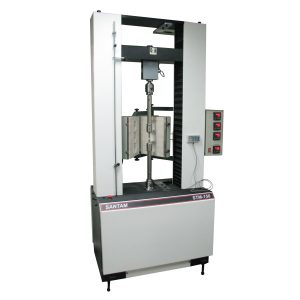
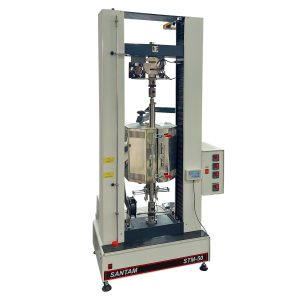
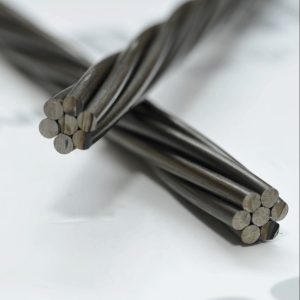
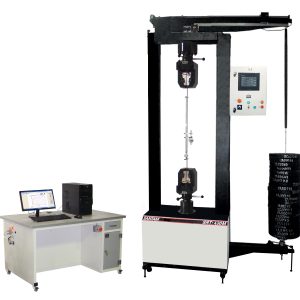
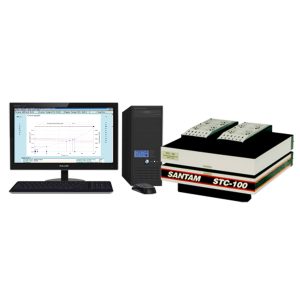
The STW-500H Torsion Testing Machine is designed to evaluate torsional strength and material resistance against rotational (torsional) forces, as well as determining shear properties in wires in accordance with applicable standards.
The machine operating mechanism is servo electromechanical using AC servo motor and servo drive, and gearbox. It features an accurate torquemeter (with an accuracy better than 1% of reading in the range of 2-100% of the machine capacity) and an accurate angle measurement transducer (resolution: 0.001°)
The STW-500H Torsion Testing Machine is equipped with hydraulic grips specially designed for testing high-strength wires, including prestressed wires and wire ropes. These specimens typically have hard surfaces, making secure gripping and prevention of specimen slippage challenging during torsion testing. Hydraulic grips provide a reliable solution by applying a uniform clamping force around the specimen through hydraulic pressure. The uniform clamping force helps minimize localized stress concentration and specimen damage at the gripping points, which could otherwise cause premature fracture and lead to unreliable test results. For secure clamping of these types of wires, the machine is equipped with alloy steel three-jaw chucks with a hydraulic clamping mechanism, designed to provide secure gripping and prevent specimen slippage during testing. The system includes a hydraulic power unit, control system, and portable control keypad for convenient opening and closing of the grips.
Torsion test can be performed with maximum speed of 30 RPM (3.14 rad/sec or 10800 degree/min) and minimum speed of 0.01 RPM (0.001 rad/sec or 3.6 degree/min) during torsion in one direction or twisting with specified turns (10 turns clockwise and 10 turns counterclockwise automatically)
It is fully computerized system connected to a PC via an RS-232 serial port using Digital Signal Processing (DSP) software technology.
The user-friendly software plots torque versus angle of twist curves and generates comprehensive reports, including data for stress shear (τ), shear strain (γ), shear modulus, yield shear strength, torsional toughness, test speed, specimen dimensions, graph analysis. Furthermore, the software identifies key structural points directly on the graph, such as the ultimate torque, fracture torque, yield point torque, and angle of twist at fracture.
Equipped with a transparent safety guard to protect the operator from flying debris or specimen fragments in the event of specimen failure.
For enhanced user-friendliness, the machine is equipped with an independent control keypad featuring JOG buttons for controlling grip rotation and positioning the specimen.
Additionally, the machine is supplied with accessories for torsional torque calibration, allowing the customer to perform routine and periodic performance calibrations, complete with an instruction manual.
The Torsion Testing Machines, available in various capacities, have a wide range of applications in industrial and R&D environments. They are primarily used for quality control and performance evaluation of wires, materials, and components subjected to torsional loads, including:
• Automotive industry: crankshaft, cardan shaft, torsion springs, shafts and axles, bolts and nuts
• Aerospace industry: helicopter and turbine blades, aircraft body and wing components, aircraft control wires and cables
• Construction industry: steel rebars, prestressed cables, wire ropes, and steel cables
• Wire and cable industry: quality control of steel, copper, aluminum, and alloy wires
• New materials development: development and evaluation of new wires and alloys with improved mechanical properties
• Energy industry: oil and gas equipment, wind turbines, and gas turbine shafts
• Drilling industry: drilling pipes and rods
• Medical applications: surgical instruments, and medical implants
• Research and development: industrial R&D centers, universities and research institutions