بازدیدکننده گرامی این صفحه در حال بروزرسانی و بازطراحی میباشد لذا ممکن است در حال حاضر برخی از مطالب قابل رویت نباشند

  • VICAT test according to ISO 2507, ISO 306, ASTM D1525, ISIRI 6982
  • HDT test according to ASTM D648, ISO 75, ISIRI 6845
  • Digital temperature control by PID controller to check the oil temperature with definable thermal rate of 50˚C/hr and 120˚C/hr (other rates can also be applied)
  • Equipped with calibration system to verify the actual load of weights on sample and obtain buoyancy forces and digital indicators forces (spring forces) for compensating them in test calculations
  • An electric stirring system with automatic control to heat the oil uniformly and help the oil to cool down at the end of the test
  • Max test temperature 250˚C, with heat resistant silicone oil in oil bath (can be increased to 300˚C if required)
  • Weights with values of 2n (n=1, 2 … 11) to apply the exact load on each cell as well as standard weight for VICAT test
  • Water cooled system to cool the oil down to ambient temperature at the end of each test

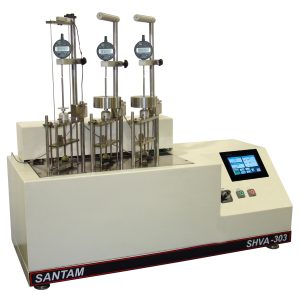
Many plastic materials do not have certain melting points. Therefore, a specific criterion must be defined as the softening point which is obtained by SHV-303. In SANTAM machines, the capability of VICAT and HDT testing is included for each cell individually. For this purpose, two types of needle and round shape probes (which are replaceable) are used for VICAT and HDT tests to apply the load. In HDT tests, three support lengths can be selected accurately as per the standard because the specimen should pass 3-point flexure test. In this test, the load is applied by standard weights in binary form by means of the plunger to the center of the test piece then the sample is plunged into oil and heated with a specific rate leading to deformation and is measured by a dial gauge with accuracy of 0.01mm. In VICAT test, the standard load is 5N and 10N that is applied by a needle-shaped indenter on the circular or square discs. The rest of the test is the same as HDT test. Each test cell has a special design to take the test sample out of the oil or get it into the oil by means of a locking mechanism. Weights loading and unloading, accurate height adjustment of the dial gauge and keeping the spring force on the specimen constant, is performed by other mechanisms. Silicone oil is used to transfer heat to plastic samples. The oil is heat resistant up to 250˚C. There is an alarm for controller oil overheat that stops the increase in heat. Thermostat overheat protection system is used for more safety. An accurate sensor and PID controller (0.1˚C resolution) control the oil temperature that can increase the heating rates to 50˚C/hr and 120˚C/hr (other rates can be applied). Moreover, a sensor is located beside each cell to report the samples temperature. A special stirring system is used to keep oil temperature constant in each test procedure in all cells. After finishing the test, the result of each cell is recorded, and the average is reported. By pushing a button, the cooling system is activated to cool the oil temperature down to the ambient pressure. Direct calibration of weights in each cell (taking into account the oil buoyancy force and the applied load of dial gauge spring) is another capability of the machine, which verifies the accuracy of values and loads in each step of the test. For calibration of the temperature sensors, a special place next to each sample is foreseen. It has a touch screen HMI display (LCD) using PLC system that indicates all measuring tools, implements all commands, and draws the specimen deflection or deformation graphs when temperature increases in each cell.

SHV-303 is intended to determine the thermoplastics and rubbers deformation (softening point) while applying the force with increase in. It is widely used in research and development programs of manufacturing companies, QC of products as well as academic institutions.

•QC of polymers

•Teaching and learning the academic subjects

•Research on new polymers

Reviews

There are no reviews yet.

Be the first to review “SHV-303
To inquire about the product price, copy its code
Product Name:

قبل از ادامه دادن، مطمئن شوید که نام محصول را کپی کرده‌اید

برای دسترسی به این فرم لازم است به حساب کاربری خود در سایت سنتام وارد شوید

سازنده:

شرکت طراحی مهندسی سنتام

استعلام قیمت

درخواست مشاوره

دانلود کاتالوگ

شرایط تحویل حضوری

شرایط تحویل کالا در محل کارخانه

جزییات بیشتر

شرایط ارسال دستگاه

شرایط ارسال دستگاه و حمل آن

جزییات بیشتر

متن آزمایشی

متن آزمایشی

جزییات بیشتر

گارانتی دستگاه

شرایط خدمات پس از فروش

جزییات بیشتر

جزییات بیشتر

  • VICAT test according to ISO 2507, ISO 306, ASTM D1525, ISIRI 6982
  • HDT test according to ASTM D648, ISO 75, ISIRI 6845
  • Digital temperature control by PID controller to check the oil temperature with definable thermal rate of 50˚C/hr and 120˚C/hr (other rates can also be applied)
  • Equipped with calibration system to verify the actual load of weights on sample and obtain buoyancy forces and digital indicators forces (spring forces) for compensating them in test calculations
  • An electric stirring system with automatic control to heat the oil uniformly and help the oil to cool down at the end of the test
  • Max test temperature 250˚C, with heat resistant silicone oil in oil bath (can be increased to 300˚C if required)
  • Weights with values of 2n (n=1, 2 … 11) to apply the exact load on each cell as well as standard weight for VICAT test
  • Water cooled system to cool the oil down to ambient temperature at the end of each test

Many plastic materials do not have certain melting points. Therefore, a specific criterion must be defined as the softening point which is obtained by SHV-303. In SANTAM machines, the capability of VICAT and HDT testing is included for each cell individually. For this purpose, two types of needle and round shape probes (which are replaceable) are used for VICAT and HDT tests to apply the load. In HDT tests, three support lengths can be selected accurately as per the standard because the specimen should pass 3-point flexure test. In this test, the load is applied by standard weights in binary form by means of the plunger to the center of the test piece then the sample is plunged into oil and heated with a specific rate leading to deformation and is measured by a dial gauge with accuracy of 0.01mm. In VICAT test, the standard load is 5N and 10N that is applied by a needle-shaped indenter on the circular or square discs. The rest of the test is the same as HDT test. Each test cell has a special design to take the test sample out of the oil or get it into the oil by means of a locking mechanism. Weights loading and unloading, accurate height adjustment of the dial gauge and keeping the spring force on the specimen constant, is performed by other mechanisms. Silicone oil is used to transfer heat to plastic samples. The oil is heat resistant up to 250˚C. There is an alarm for controller oil overheat that stops the increase in heat. Thermostat overheat protection system is used for more safety. An accurate sensor and PID controller (0.1˚C resolution) control the oil temperature that can increase the heating rates to 50˚C/hr and 120˚C/hr (other rates can be applied). Moreover, a sensor is located beside each cell to report the samples temperature. A special stirring system is used to keep oil temperature constant in each test procedure in all cells. After finishing the test, the result of each cell is recorded, and the average is reported. By pushing a button, the cooling system is activated to cool the oil temperature down to the ambient pressure. Direct calibration of weights in each cell (taking into account the oil buoyancy force and the applied load of dial gauge spring) is another capability of the machine, which verifies the accuracy of values and loads in each step of the test. For calibration of the temperature sensors, a special place next to each sample is foreseen. It has a touch screen HMI display (LCD) using PLC system that indicates all measuring tools, implements all commands, and draws the specimen deflection or deformation graphs when temperature increases in each cell.

این بخش در حال بروز رسانی می باشد...

[ywtm_content]

این بخش در حال بروز رسانی می باشد...